Please join us in congratulating our 2025-26 Senior Thesis writers for all of their hard work and efforts in the Senior Thesis Program! These undergraduate students did an outstanding job and will receive the Oscar Lee Award for Senior Thesis Writers for their achievements.
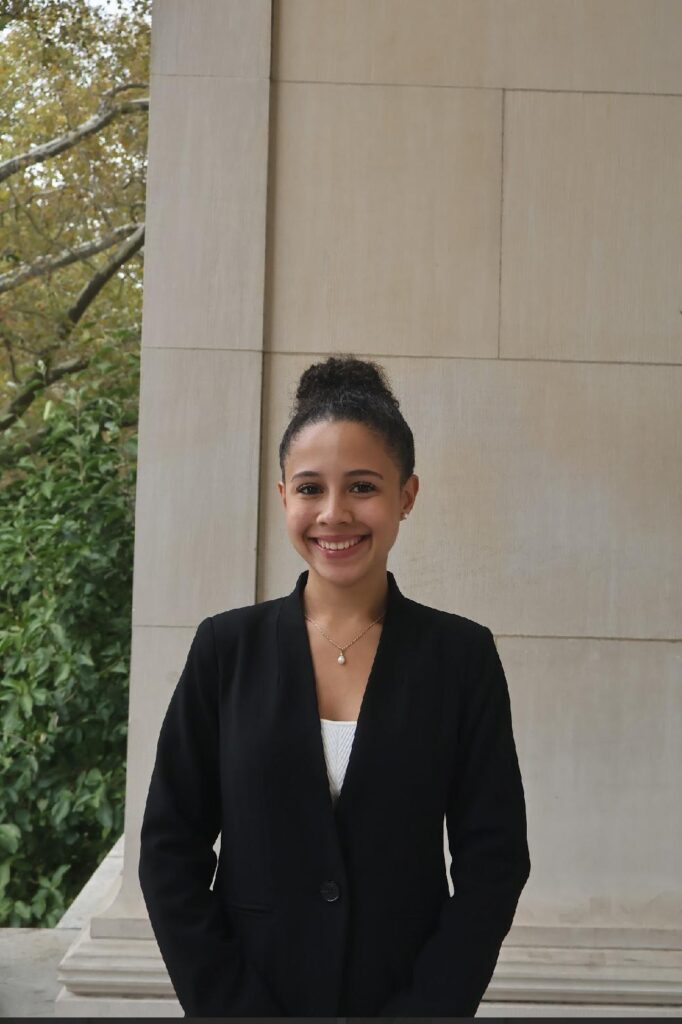
Bio: Alexis Alton is a member of the Columbia College Class of 2026, majoring in East Asian Studies with a minor in Science & Society. Her areas of interest are twentieth and twenty-first century Chinese culture, with a focus on visual culture, media, and women’s studies. Her senior thesis – entitled French Braids, Rosy Cheeks, and Succulent Fruit: Addressing Chinese Propaganda Poster Representations of Nature and Female Figures During the Great Leap Forward – focuses on Great Leap Forward propaganda poster representations of the relationship between nature and women and girls. Outside of the classroom, she enjoys theater, reading, creative writing, and spending time with her goldendoodle puppy Coco de Chanel. After graduation, Alexis plans to pursue graduate studies.
Abstract: This thesis addresses how Great Leap Forward propaganda posters mediate the relationship between female subjects and nature in line with the theoretical framework of ecofeminism. This thesis highlights how these posters work to produce a cultural vision of femininity, productivity, and gendered national identity. Employing a curatorial approach and using visual analysis, this thesis analyzes how specific visual and caption choices imbue these posters with prescriptive messaging, shaping the cultural role of women and girls.
By making use of representations of cotton, produce, and flowers, this thesis explains how propaganda posters shape the role of women and girls during the Great Leap Forward. Through an analysis of cotton-centric posters, this thesis presents how women’s and girl’s engagement with labor emerges alongside notions of national duty, individuality, happiness, and play. The discussion of food provides an entry point for this thesis to examine idealized images of childhood and health as well as the idea of women as beings with productive and reproductive value. Flowers serve as a mechanism for assessing urban women’s relationship to nature by showcasing women’s contributions to the Great Leap Forward outside of the fields and productive labor. This thesis closes by illustrating the continued cultural relevance of this dynamic through a discussion of how this gendered relationship to nature manifests in contemporary China.
This thesis argues that propaganda posters featuring women/girls and/in nature shape a specific idealized vision of female subjects and nature to drive development in line with China’s socialist agenda. This thesis unpacks this close connection between China’s gender progress and productive priorities, arguing that these posters address the productive, reproductive, and intrinsic value of female subjects as well as the significance of female contributions to the aims of the Great Leap Forward, ushering in a sense of gendered nationalism and a new cultural era for female actors.

Bio: Isabel Andreatta is a member of the Columbia College Class of 2026 majoring in East Asian Studies. Her area of research interest centers on visual and popular media in interwar Imperial Japan, focusing on how institutional forces and consumer culture mediated questions of modernity, power, and subjectivity. Outside of her studies, she enjoys going to the cinema, sifting through second-hand bookstores, and learning about the natural world. After graduation, she hopes to continue her research by pursuing a career in academia. Isabel’s senior thesis, written under the guidance of Professor Takuya Tsunoda, is an exploration of both space as a scholarly inquiry and of Asakusa’s entertainment culture from 1914 to 1923. By centering media objects—travel guides, maps, postcards, magazines, and ephemera—her thesis traces the relationship between theater, opera, and film and the socio-material construction of Asakusa’s identity within Asakusa and broader Tokyo.
Thesis Title: Frames of the Moving City: Urban Visuality and the Making of Asakusa, 1914–1923
Abstract: Leisurely, pensively, and impassioned by curiosity, the flâneur, more than a corporeal man, is a mode of seeing and circulating through the cacophony of the modern cityscape. And as aptly put by Scott McCracken in “The Completion of Old Work: Walter Benjamin and the Everyday,” it is “the material culture of the city, rather than the psyche, [that] provides the shared collective spaces where consciousness and the unconscious, past and present, meet. As such, this thesis seeks to understand Tokyo’s Asakusa district as a modern entertainment space from 1914 to the eve of the 1923 Kantō Earthquake, turning to the visual regime—that is, the visualscape mediated by the spatial order and material construction of space—as a starting point of my analysis. However, departing from the one-directional, subjective gaze of the flâneur, this thesis understands urban space through the lens of social networks—defined by relations, influence, structure, and movement. Doing so provokes questions beyond what is Asakusa? and what images are associated with Asakusa? to questions like who is staging Asakusa and how? By analyzing the institutional media practices of theater companies, movie studios, and other corporations involved in the entertainment industry, this thesis ultimately seeks to achieve three primary goals: i) identify the projected relationship between consumers and producers of Asakusa entertainment; ii) locate and characterize the networks of entertainment institutions; and iii) understand how the projected relationship and real power structures work together to reconfigure understandings and experiences of Asakusa as a space.

Bio: I am a member of the Columbia College class of 2026, majoring in East Asian Studies with a concentration in Computer Science. I have been learning mandarin since I was 4 years old, and have developed an interest in Taiwanese literature and history after studying in Taipei for a summer. Some of my favorite classes were “East Asian Cinema” taught by Professor Ying Qian, “Computational Sound” taught by Professor Mark Santolucito, and “Labor and Love in Modern China” taught by my faculty advisor, Professor Nicholas Bartlett. Outside of the classroom, I play the cello in various classical music ensembles and am interested in public transportation networks, minecraft, and cats. After graduation, I plan on returning home to Boston to look for opportunities in computer science, classical music performance, and east asian studies in hopes of gaining a deeper understanding of what career path I want to pursue.
My senior thesis “Infrastructure and Identity: Rail Transit and the Literary Imagination of Taiwan” melds my academic interests with my personal fascination regarding public transportation and urban studies by analyzing the way in which rail transportation shaped Taiwan’s historical development. I use literature as my main mode of analysis to understand the human experience of rail travel rather than observing rail transit as a lifeless historical artifact.
Abstract: What does it mean to be Taiwanese? The question resists easy answers. Taiwan is a place that has been named, claimed, and remade by successive powers across centuries. It is a region whose residents have been told, repeatedly and by force, who they are and what language they must speak to prove it. Out of this history of serial colonization emerges a question not only of political sovereignty but of something more intimate: the question of what, if anything, connects a people to the land they inhabit, and whether that connection can survive the weight of so many imposed reinventions.
This thesis examines rail infrastructure as one of the central material sites in which that question is negotiated. Drawing on three literary texts—Yang Shuangzi’s Taiwan Travelogue, Huang Chunming’s “Sayonara/Zaijian,” and Zhu Tianxin’s The Old Capital—I argue that Taiwan’s rail network functions as a material archive of the island’s contested history, one in which the legacies of colonial rule, authoritarian governance, and democratic aspiration are simultaneously encoded into the landscape. Rather than serving as a neutral medium of connection, rail infrastructure in Taiwan has consistently organized relationships between center and periphery, visibility and invisibility, memory and forgetting.
Each literary text illuminates a distinct dimension of this argument. Taiwan Travelogue reveals the colonial railway as a frame that structures and limits the colonizer’s perception of the occupied land, enabling a form of consumption that reproduces imperial extraction even as it disavows it. “Sayonara/Zaijian” traces the colonial railway’s postwar afterlife in the economy of Japanese sex tourism, where the train carves out a liminal space for historical confrontation while foreclosing resolution. The Old Capital presents the Taipei Mass Rapid Transit (MRT) as a democratic instrument of urban erasure. The MRT embodies an infrastructure that promises modernity while systematically destroying the spatial conditions of memory and collective belonging.
Taken together, these texts propose that decolonization in Taiwan remains incomplete not only at the level of political sovereignty but at the level of built space. True decolonization requires not only political transformation but infrastructural reimagination: a rethinking of whose memories count, whose routes matter, and whose vision of the island is reflected in the network’s design.
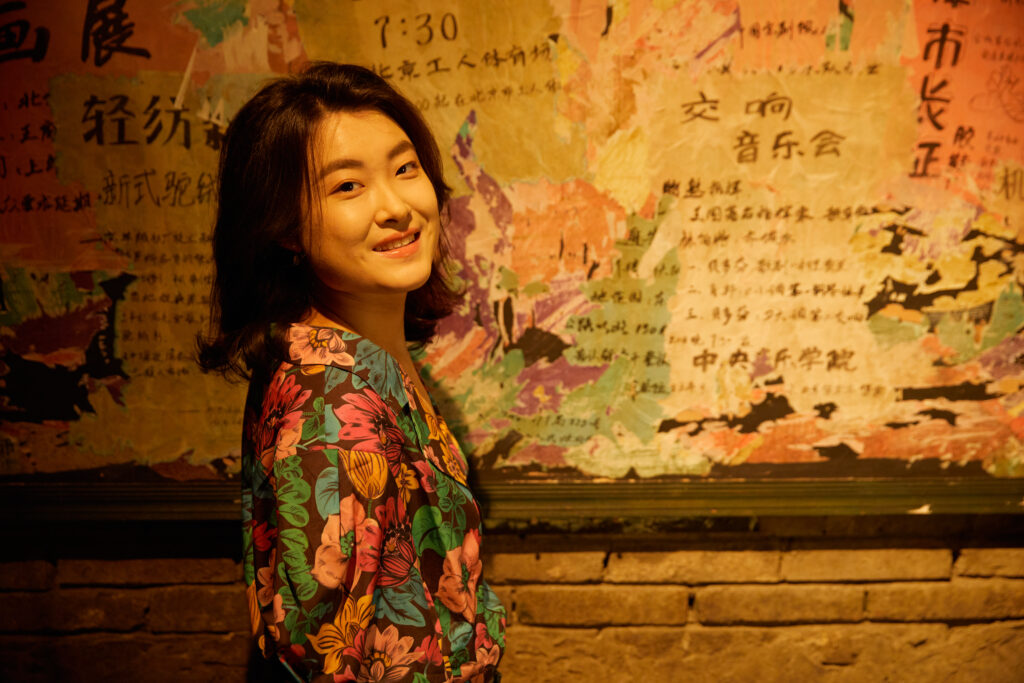
Bio: Julie Chen is a graduating senior with double majors in East Asian Studies and Comparative Literature & Society. Her EALAC senior thesis investigates island narratives and attendant issues of spatial-political legitimation, symbolic control of gender, and literati self-identification in early modern Chinese novels (Zhanghui xiaoshuo). Her comparative literature thesis works on the configuration of fungal knowledge and epistemological alterities in Chinese writings through the lens of sinographs, semantics, and translation. She has been the recipient of Columbia’s IRCPL summer research fellowship, academic editor of Columbia Journal of Asia, and the student representative on the Committee of Global Core.
Abstract: In my thesis, I foreground “islands” as a spatial lens to investigate the dynamics of male literati self-identification at critical historical junctures by analyzing three early modern Chinese “fictions” (zhanghui xiaoshuo 章回小說): Shuihu houzhuan 水滸後傳, a sequel to Water Margin composed by a Ming loyalist literati Chen Chen 陳忱 (1615-1670) during the Ming-Qing transition, the mid-Qing literati/erudition novel Jinghua yuan 鏡花緣 (“Flowers in the Mirror”) by Li Ruzhen 李汝珍 (1763-1830), and the late Qing fiction of reformation and reverse-colonization Chiren shuomeng ji 痴人說夢記 (“Tale of Dream by an Enchanted Person”) written by a relatively obscure author pen-named Lu Sheng 旅生 (?). By close reading the authors’ mediation of alternative space and critically engaging with theoretical concepts of spatial alterities such as “utopia,” “heterotopia,” and “dystopia,” I showcase both how the literary cartographies of overseas islands in the three works of fiction bespeak forms of literati dis-enchantment and re-identification with the empire, as well as the dialectical, ambiguous tension between the two affective poles, as grounded in their respective historical contexts. Another justification for pairing the three fictions stems from their shared adaptation of narratological paradigms such as the vernacular models found in Water Margin and relevant Shanhai jing and Tang chuanqi precedents. From this intertextual perspective, I propose that “islands” can serve as an effective analytical prism for tracing the genealogy of late imperial vernacular narrative modalities, alongside psychological trajectories of the narrating literati. I conclude that while Shuihu houzhuan reflects Chen Chen’s complex and at times self-contradictory negotiation with the Ming dynastic collapse when the overseas islands are turned into a site of both disenchantment and re-identification, Jinghua yuan exemplifies the mid-Qing literati’s self-reflexive celebration and satirization of “this Culture of Ours” that entertains literati erudition and transgressive fantasies in staging the tour of islands. Continuing these textual precedents which refract literati anxiety and blur the boundary between “inside” and “outside,” Chiren shuomeng ji reflects late Qing discourse which sought to cope with China’s national crisis in the face of Western colonial powers by writing a catharsis narrative that reverses the propagated evolutionary theories and racial hierarchy. Together with other peculiar enclaves in late Qing imaginaries, the reformed and “civilized” island in Chiren shuomeng ji becomes an independent yet communicable base in the open sea that claims a superior civilizational position, while symbolically enmeshing the multiple temporalities of China’s past, present, and future into its imaginative space. By conceptualizing the oscillation between utopian and dystopian impulses in these island narratives by early modern Chinese literati, I experiment with the usefulness and potential inadequacies of the theoretical lens of “heterotopia.” By adopting the term “heterotopia,” I borrow its concept from Foucault’s original context of real, social, and institutional sites and apply it to textual forms of such sites. I aim to emphasize at once the embeddedness of those peculiar enclaves within the empire’s larger normative structures and the imagined islands’ subversiveness in cracking crevices out of cultural monoliths and dominant ideologies. This attempt is intended to be in conversation with previous “utopian” frameworks that primarily emphasize the alternative space as sites of disengagement and new possibilities, potentially overlooking the complicities and ambiguities of such idealized sites. Meanwhile, I propose that a “symptomatic reading” approach, through close analysis that focuses on contradictions, absences, and gaps in texts, and that inquires into the repressed articulations and desires behind them, is conducive to the project’s thematic concerns with male literati psychology in relation to their identification with the empire/nation. My central intervention in this thesis is to contend that the seemingly “marginal” space of islands (in both textual and historical senses) is an eventful, symptomatic, and resourceful site for reconsidering the “canonical” question of literati self-identification and self-representation in studying late imperial Chinese fiction.

Bio: Domenico Pica is a member of the Columbia University School of General Studies Class of 2027, double-majoring in Computer Science and East Asian Languages and Cultures. His research sits at the intersection of Korean history, technology governance, and computing theory. Before Columbia, Dom began his military career in 2013 as a chaplain’s assistant in a Civil Affairs battalion, later serving as a forward observer with the 3rd Ranger Battalion before transitioning back to Civil Affairs. With 13 years and continuing, this military background shaped the analytical perspective of his thesis. After graduation, he intends to pursue graduate study in preparation for a career in cyber policy/posturing advising.
His senior thesis, “Strategic Ambiguity and Technological Vision: Park Chung Hee’s ‘Brain Industry’ Initiative and Korean Computing Development,” written under the supervision of Professor Seong Uk Kim, examines how the Park Chung Hee regime used strategic ambiguity — the deliberate maintenance of dual civilian and military framings — as a governance mechanism for computing and technology development during South Korea’s Fourth Five-Year Economic Development Plan (1977–1981).
Abstract: This thesis examines how Park Chung Hee’s regime employed strategic ambiguity—the deliberate maintenance of dual civilian and military framings—as a governance mechanism for computing and technology development during South Korea’s Fourth Five-Year Economic Development Plan (1977-1981). Drawing on declassified CIA intelligence assessments from 1983–1984, official Korean planning documents, the published scholarship of Kim Hyung-A and Peter Banseok Kwon, and personal correspondence with Kwon, I argue that the consistent civilian framing of the “brain industry” (두뇌산업) initiative was not accidental or merely rhetorical but constituted a deliberate policy design.
By maintaining workforce development language around what was, in practice, a dual use technology program with defense implications, the regime secured chaebol participation, avoided provoking scrutiny from the United States and Japan, the primary sources of essential technology transfers, and preserved flexibility for a developmental state navigating the tensions between economic growth and national defense after the Nixon Doctrine. Analyzing official documents, worker testimonies, and state-corporate relations, I show that strategic ambiguity operated not as concealment but as a layered system in which different actors—elite planners, factory workers, chaebol executives, and foreign partners—each encountered a version of the truth that was genuine but partial, sufficient to motivate participation without requiring any single actor to acknowledge the program’s full duality.
Grounded in Alan Turing’s insight that digital computing is inherently a universal technology, incapable of being cleanly divided into civilian and military categories, this thesis offers a historical case study with direct relevance to contemporary debates over dual-use technology governance, semiconductor export controls, and the monitoring of emerging technologies in states.
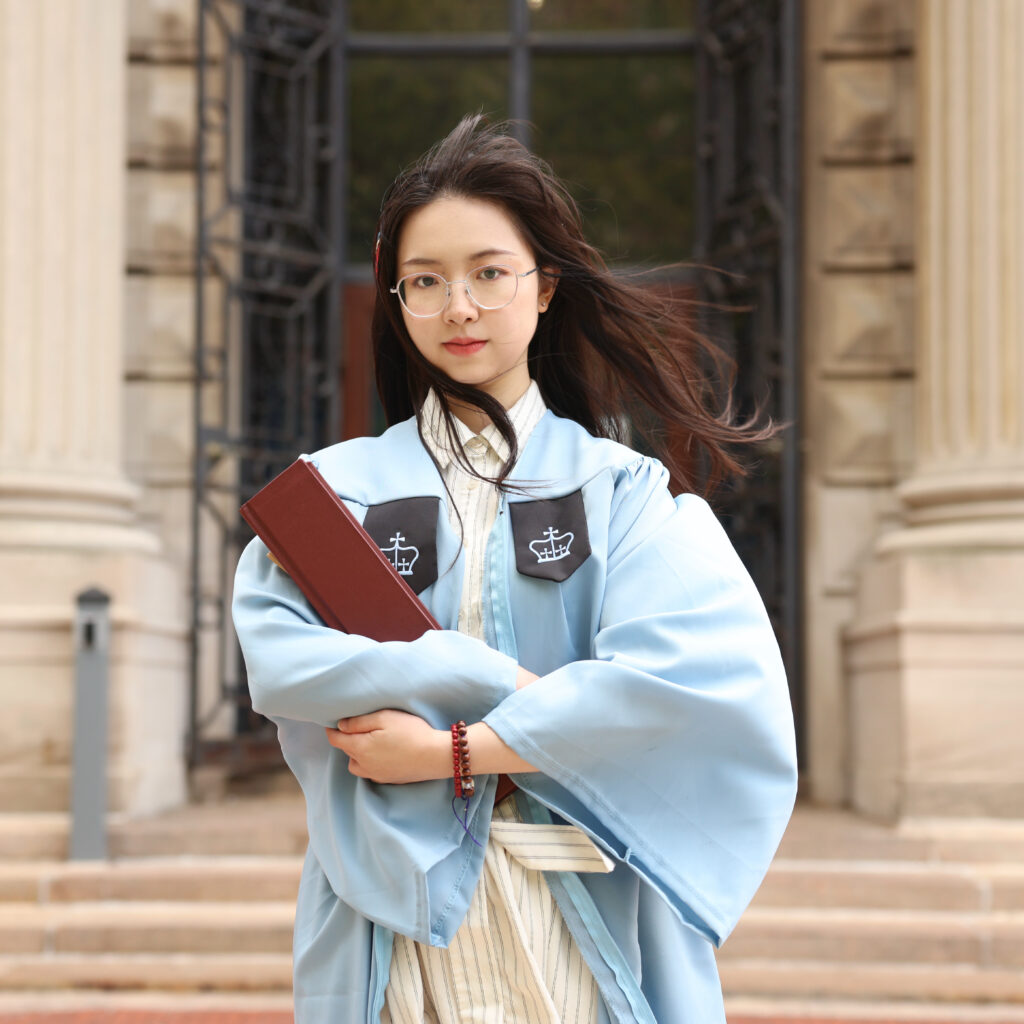
Bio: Yuhan is in the Dual BA program between Columbia University (BA of Art) and City University of Hong Kong (BA of Social Science), majoring in East Asian Studies in both institutions. Born and raised in Yunnan, she has long been drawn to the cultural, linguistic, and religious worlds that are both diverse and interconnected across the multiethnic regions of the plateaus. Near these layered plateau lifeworlds and landscapes, she became particularly interested in Tibetan cultural forms in both historical and contemporary contexts, especially visual culture, performance, ritual, and the ways aesthetics are represented, transformed, and mediated across different political and social settings. Her senior thesis, Aesthetics in the Television Tibetan Losar Galas (2003–2025) and Their Alignment and Negotiation with National Narratives, is developed from her final project for Dr. Lauran R. Hartley’s “Tibet in the World” course, and later expanded the project into a broader study of televised performance, Tibetan aesthetics, and cultural politics. Beyond the classroom, Yuhan creates art inspired by the murals of the Hexi Corridor and everyday life in Yunnan. As she continues into the MA program, she looks forward to deepening her work in Tibetan Studies while keeping her intellectual and artistic practice open, interdisciplinary, and exploratory.
Abstract: On Losar (Tibetan New Year) evening, celebrations unfold in living rooms warmed by guests, chatter, and steaming cups of tea. Television always flickers behind everything: elders drink ston chang and lo chang, children drift in and out of the room, and relatives gather around long sofas covered with rugs as traditional songs play from the TV. The television is not the center of attention, yet it is unmistakably present and will most likely feature the Tibetan Losar Gala (lo gsar gyi mnyam spro’i mtshan tshogs) that repeatedly broadcasts during most holiday hours. Similar to CCTV’s Spring Festival Gala (yangshi chunwan), watching the Losar Gala has become a recognizable ritual in Tibetan New Year celebrations. Being the most widely viewed and culturally influential televised Tibetan language program of the year, it offers a valuable site for examining how Tibetan aesthetics is staged and shaped by television broadcasting and national frameworks. This thesis asks: in what ways do Losar Gala performances diverge from and localize dominant aesthetic and representational frameworks through which national narratives and priorities are conveyed? More specifically, how do songs, colors, and other specific visual and sensory features draw on and negotiate local traditions, artists’ creative efforts, and state-framed representations? And how do these aesthetic choices change or persist across the period from 2003 to 2025? I argue that the Losar Gala should be situated both as a national television ritual and as a performing arts production; it is a space of presenting political significance, national imagination, and social identity, that is directly concerned with mediating ethnic relations and staging cultural diversity. It constructs “Tibetanness” through selective cultural markers, including region-specific Tibetan genres, costumes, props, landscapes, ritual objects, and symbols, such as chemar, khata, Potala palace, etc. They are excerpted, compressed, and rearranged according to the demands of television spectacle or messaging purposes. The Gala displayed local diversity, but ultimately synthesized into a unified image of Tibet as an auspicious, pastoral, sacred, pure, historically grounded, culturally vibrant, and politically harmonious region. It is overall positive, yet it is repeatedly associated with a romanticized imagination of a land of singing and dancing people, purity, hospitality, nature, harmony, and innate cultural expressiveness. From 2003 to 2025, the Gala moved from a relatively simple regional cultural variety show toward a technologically sophisticated aesthetic regime increasingly aligned with national festive aesthetics, especially those of the Chinese Spring Festival. Its aesthetic choices therefore, operate as technologies of affective governance: they make these narratives felt through color, rhythm, choreography, sound, bodies, costumes, and atmosphere. However, the aesthetic production is not just top-down: choreographers, singers, costume designers, ICH bearers, and performers exercise real and active creative agency, and are supported yet bounded within state institutions, policy support, funding structures, television demands, and official frameworks of cultural preservation.

