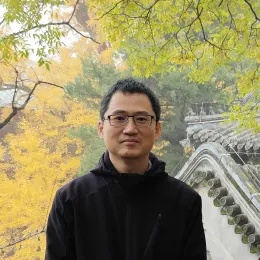
 Jin Xu
Jane and Leopold Swergold Associate Professor of Chinese Art History
Education
PhD: The University of Chicago, 2017
Research Interests
Art and Architecture in China
Biography
Jin Xu specializes in pre-modern Chinese art history, with particular interest in art and architecture during the imperial period (221 BCE–1911 CE). His research focuses on the artistic expressions of migrants and their communities, including both non-Chinese immigrants in China and Chinese emigrants in border regions. He seeks to understand how the experience of migration shaped perceptions of art and how art, in turn, helped individuals make sense of their migratory lives and heritage. In his work, he also emphasizes the significance of material properties and technical processes in informing ways of seeing.
Over the years, he has studied stone coffins and funerary couches from the Northern Dynasties (386–581), a period that witnessed an influx of Central Asian immigrants, notably the Iranian-speaking Sogdians from present-day Uzbekistan and Tajikistan. His first book, The Silk Road with Many Faces: Sogdian Immigrants in Early Medieval China (forthcoming, Oxford University Press), demonstrates the various ways—material, pictorial, and architectural—in which Sogdian immigrant leaders and their families expressed their multifaceted life experiences through stone burial furniture.
He is currently completing a book on figural representations from the Northern Wei (386–534), the first major dynasty in Chinese history founded by nomadic immigrants. This project examines a variety of artistic media commissioned by people from diverse ethnic and cultural backgrounds. It addresses key issues in Chinese art history, such as images of the deceased, the roles of women as patrons and viewers, and interactions between Buddhist and indigenous Chinese artistic practices. He is also working on papers about the art and architecture associated with immigrants during the reign of the Qianlong emperor (1711–1799) of the Qing dynasty (1644–1911).
His teaching covers a wide range of topics, including inter-regional artistic exchanges within East Asia, religious and funerary art, the art of the Silk Road, artistic materials and techniques, objects study, images and texts, rubbings and prints, and architecture and gardens. Before joining Columbia, he taught in the Art Department at Vassar College.
Prospective PhD applicants are welcome to reach out and share their application materials. However, due to the high volume of inquiries, I may not be able to respond to every email, especially if your research interests do not closely match mine.
Selected Publications
“Prayer Hall Under the Imperial Gaze: The Qianlong Emperor (1711-99) and the Huiziying Mosque,” Journal of the Society of Architectural Historians, 85.3 (2026) [Forthcoming].
“A Central Asian Steed with a Chinese Spirit: Han Gan’s Night-Shining White and the Transformation of Horse Paintings in Eighth-Century China,” Orientations, no.3 (2026) [Forthcoming].
“Love, Luxury, and Live Spectacle: Narrative Paintings and Women’s Patronage under the Northern Wei,” The Art Bulletin, no. 3 (2024) : 91-116.
“Evoking the Past: The Ning Mao Sarcophagus and Images of the Deceased in Early Medieval China,” Early Medieval China (2024).
“Monsters on an Imperial Stone Base: Reconstructing Seven Stone Panels from Xiangtangshan,” Orientations, no.1 (2024): 12-20.
“Echo of a Distant Past: Sino-Sogdian Elements in Persian Book Illustrations,” co-authored with Taylor Chisato Stewart, Orientations, no.1 (2022), 61-68.
“Symbol of Universal Kingship: A Study of the Imagery on the Brocade with Lion Hunting in the Horyuji Temple,” Sino-Platonic Papers, no. 307 (2021).
“A Journey across Many Realms: The Shi Jun Sarcophagus and the Visual Representation of Migration on the Silk Road,” The Journal of Asian Studies, no.1 (2021): 145-65. Chinese translation by Huang Wen-Yi, in Newsletter of Institute of Chinese Literature and Philosophy, Academia Sinica, no.1 (2023): 27-51.
“Evanescent Temple, Eternal Dharma: The Wanfa Guiyi Hall in the Post-Qianlong Era of the Qing Dynasty (1644-1911),” Orientations, no. 1/2 (2021): 21-29.
“Recovering the Honor of a Royal General: The ‘Yuan Mi’ Sarcophagus Reattributed,” Orientations, no.7/8 (2020): 58-65.
“The Funerary Couch of An Jia and the Art of Sogdian Immigrants in Sixth-Century China,” The Burlington Magazine, no.10 (2019): 820-29.
“A Natural Approach to Nature: Two Late Northern-Wei (494-534 CE) Pictorial Stones in the Art Institute of Chicago,” Orientations, no.11 (2017), 82-90.
“孩而至孝: 北魏孝子棺考證” (Child of Supreme Filial Piety: A Study of the Filial Piety Sarcophagus), 《美術大觀》, no.1 (2022).
“美國藏洛陽北魏孝子石葬具墓主身份略考” (A Study of the Owners of Northern-Wei Funerary Furniture with Filial-Son Illustrations from Luoyang in American Collections), co-authored with Ma Xiaoyang, 《書法叢刊》, no.1 (2021).
“美國納爾遜博物館藏北魏孝子石棺床圍屏圖像釋讀” (A Study of the Filial-Son Illustrations on a Northern-Wei Stone Funerary Couch at the Nelson-Atkins Museum of Art), 《中國國家博物館館刊》, no.10 (2019).
“波士頓美術館藏北魏孝子石棺床的復原和孝子圖像研究” (Reconstruction and Study of a Northern Wei Stone Mortuary Couch with Filial Piety Illustrations at the Museum of Fine Arts in Boston), 《古代墓葬美術研究》, no.3 (2015).
 Matthew McKelway

