• Skip to main content
  • Skip to footer

  • ABOUT
    • Greetings from the Department Chair
    • Department History
    • News
    • Affiliates
    • Support
    • Contact EALAC
  • PEOPLE
    • Faculty
    • Administration
    • Graduate Students
    • Recent Alumni
  • PROGRAMS
    • Undergraduate
    • Graduate
    • Language Programs
    • Academic Year 2025-2026 Courses
  • EVENTS
  • SUPPORT

news

Alice Travers’ Talk on March 28th

By Bart Qian

On March 28th, WEAI and the Modern Tibetan Studies Program hosted Alice Travers, a permanent researcher in the CNRS (French National Centre for Scientific Research) and a member of CRCAO (Centre for Research on East Asian Civilisations – UMR 8155) at the Collège de France in Paris. The talk was moderated by Professor Gray Tuttle.

Dr. Alice Travers discussed the social history of 18th, 19th and 20th century Central Tibet and the Ganden Podrang government and its institutions as the Principal Investigator of the project, “The Tibetan Army of the Dalai Lamas, 1642-1959,” at the Sorbonne, Paris.

During the eighth century, the Tibetan Empire (618-842) conquered a region encompassing sections of modern-day Afghanistan, India, Xinjiang (Eastern Turkistan), and parts of China proper, and its army made Tibet one of the major powers in Eurasia. Though the Tibetan military declined drastically after the collapse of the empire, military culture continued to influence Tibetan civil and religious society. Popular perception views Tibet as a passive agent, receiving Mongol and Manchu aid for military affairs. For instance, the current mainstream Chinese academic literature credits the Manchu general Fuk’anggan (1753-1796) for helping establish and train the Tibetan army after the Gurkha Wars ended in 1792. These assumptions, however, ignore the Ganden Podrang’s active pursuit of military and state-building deployment since its foundation.

Dr. Travers based her research on the model developed for her database on 19th and 20th century Central Tibetan aristocrats, which explored the social mobility of Tibetan civil officials in this period. The audience asked multiple questions on the Tibetan military and Professor Tuttle commented on the conscious state practice of deploying military officials and soldiers to sites far from their home areas in the 19th and 20th century, which suggests that Tibetan troops were not simply local militia
A Conversation on Early Gelug Institutional History with José Cabezón

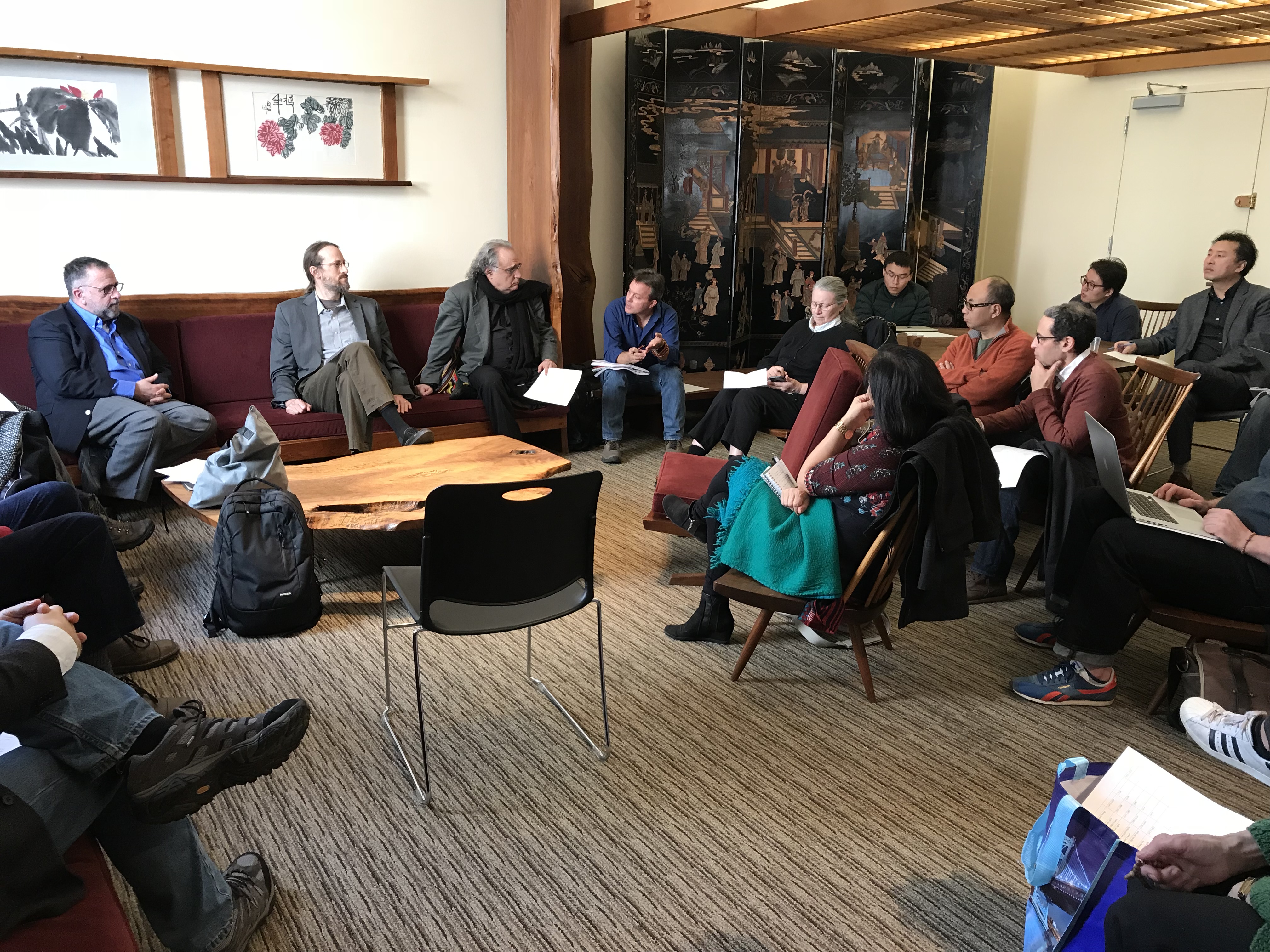
A Conversation on Early Gelug Institutional History with José Cabezón (far left)

By Constantine Lignos

Over the Spring Break, WEAI and the EALAC department hosted a conversation with the University of California, Santa Barbara’s Dalai Lama Professor, Dr. José Cabezón, moderated by EALAC’s Leila Hadley Luce Associate Professor of Modern Tibetan Studies, Dr. Gray Tuttle. Dr. Cabezón spoke about the institutional history of the Gelug school of Tibetan Buddhism in celebration of the 600th anniversary of both the death of Tsongkhapa and the construction of the Sera Monastery just outside of Lhasa. The event gathered Columbia students, faculty, and friends for an hour-and-a-half-long informal conversation, followed by a traditional Tibetan lunch with Dr. Cabezón. Dr. Cabezón laid out his theoretical framework underpinning the strength of the Gelug school in Tibet which he attributed to the homogenization of and the consistency between Gelug monasteries.

Dr. Cabezón’s talk reflects his current research project on the Sera monastery, where Dr. Cabezón lived and studied from 1980 until 1985. Since then, Dr. Cabezón has been collecting materials for this new endeavor. In the early 2000’s, Dr. Cabezón returned to the Sera Monastery with his photographer. Pieces of his research project are posted on seramonastery.org. Additionally, Dr. Cabezón has two forthcoming books, Sexuality in Classical South Asian Buddhism and a translation of Mipam’s Treatise on Royal Ethics.

Despite the Spring Break, Dr. Cabezón’s lecture was well-attended. Students, faculty, and the larger Columbia community remained thoroughly engaged in Dr. Cabezón’s talk and asked thoughtful and insightful questions.

The Department of East Asian Languages and Cultures invites applications for a Lecturer in Discipline in Chinese history, literature, or visual culture, to begin July 1, 2018.

The Department of East Asian Languages and Cultures invites applications for a Lecturer in Discipline in Chinese history, literature, or visual culture, to begin July 1, 2018. The Lecturer in Discipline will be expected to be the MA Program Director in East Asian studies. The successful candidate will teach Chinese Civilization (a Columbia College Global Core course), a methodology course, and course in his or her specialty. This is a full-time, renewable position with multi-year renewals contingent on successful reviews. PhD at the time of appointment required.

Review of application will begin immediately and preference will be given to applications submitted by April 15, 2018.
academicjobs.columbia.edu/applicants/Central?quickFind=66047

  • « Go to Previous Page
  • Go to page 1
  • Interim pages omitted …
  • Go to page 22
  • Go to page 23
  • Go to page 24
  • Go to page 25
  • Go to page 26
  • Interim pages omitted …
  • Go to page 33
  • Go to Next Page »

Before Footer

EALAC – Columbia University
407 Kent Hall 1140 Amsterdam Ave.
MC 3907  New York, NY 10027
tel:212.854.5027

Footer

  • Facebook
  • Instagram
  • Twitter
  • ABOUT
  • PEOPLE
  • PROGRAMS
  • EVENTS
  • SUPPORT

Copyright © 2025 · Columbia University Department of East Asian Languages and Cultures

Copyright © 2025 · EALAC on Genesis Framework · WordPress · Log in