• Skip to main content
  • Skip to primary sidebar
  • Skip to footer

  • ABOUT
    • Greetings from the Department Chair
    • Department History
    • News
    • Affiliates
    • Support
    • Contact EALAC
  • PEOPLE
    • Faculty
    • Administration
    • Graduate Students
    • Recent Alumni
  • PROGRAMS
    • Undergraduate
    • Graduate
    • Language Programs
    • Academic Year 2025-2026 Courses
  • EVENTS
  • SUPPORT

Search Results for: japanese pedagogy

Filed Under: Uncategorized


Meet our 2022-23 EALAC Undergraduate Senior Thesis Writers!

Meet our 2022-23 EALAC Undergraduate Senior Thesis Writers!

Please join us in congratulating our undergraduate 2022-23 Senior Thesis writers for all of their hard work and efforts in the Senior Thesis Program! These students did an outstanding job and will receive the Oscar Lee Award for Senior Thesis Writers for their achievements.

Lucas Aramburu, CC ’23

Bio: Lucas Aramburu is a member of the Columbia College class of 2023 majoring in East Asian Studies with a concentration in Business Management. Lucas’ area of interest is Chinese politics, language, and culture, specifically relating to Chinese presence in Latin America. Outside of these interests Lucas also has a passion for psychology, literature, and distance running. 

Abstract: Since 2015, the Colombian government has contracted Chinese State-Owned Enterprises (SOEs) to construct a flurry of public works as part of a national push to modernize the country’s notoriously poor transportation infrastructure. In the background of this exponential increase in Chinese presence in Colombia, there remains a memory of political and environmental conflicts arising from Chinese SOE activity in Colombia’s rich oil industry, resulting in local opposition to Chinese investment in the country. The recent acceptance of Chinese investment in infrastructure, in contrast to poor political perceptions of Chinese SOEs in the country, raises questions surrounding the “learning curve” of Chinese firms abroad: namely, whether there are discernable patterns of Chinese behavior towards social opposition, regulatory hurdles, and political complexity in Colombia.

By examining the history of Chinese involvement in Colombia, this thesis argues that while complex relationships between political and industry conditions make it difficult to identify a uniquely “Chinese” way of doing business, these firms generally adhere to local industry practices. Initial Chinese investments in Colombia were molded by private motivations in the oil sector and met with a receptive Colombian environment that was beholden to poor regulations and social conflicts. In the transportation sector, a new set of challenges was also met with the adoption of industry norms, though a focus on building clientelistic political relationships in Colombia incentivized Chinese firms to be more responsive to social and political challenges.


Tasnim Azman, CC ’23

Bio: Tasnim Azman (she/her) is a member of the Columbia College Class of 2023 majoring in East Asian Studies. Her main area of interest is Japanese history, focusing on Japanese imperialism in Southeast Asia during the Pacific War. She is currently writing her thesis, titled “Resisting the Rising Sun: A decolonized examination of Chinese-Malay Solidarity in the Malayan Communist Party under Japanese Occupation in World War II Malaya,” under the tutelage of Dr. Paul Kreitman. In it, she challenges the now-normative view of race relations during the period — that tensions between ethnic Malays and Chinese in World War II Malaya were indiscriminately rife — by examining the outward role and internal dynamics of the Malayan Communist Party. 


Her academic interests include race and ethnicity, gender studies, and postcolonial theory. In her free time, she can be found playing board games with friends, arranging music, watching Survivor, or singing. After graduating, she intends on pursuing graduate studies in Education to receive teaching certification, hoping to move home to play a role in dismantling educational inequality in Malaysia.

Abstract: This thesis examines how the Malayan Communist Party (MCP) mobilized interethnic solidarity as a tool of resistance against the Imperial Japanese administration’s attempt to divide and rule Malaya during the Pacific War. I argue the aforementioned by analyzing Chinese-Malay relations within the MCP in particular. I do this by investigating the MCP’s motivations for fostering solidarity, the means through which that was achieved, and the significance of certain high-ranking Malay officials in the MCP. Central to this thesis is decolonization theory, which urges a reexamination of race relations in 1940s Malaya. The normative understanding of race relations in Japanese-occupied Malaya is that the local ethnic groups were strictly in opposition to one another. I argue that this interpretation of interethnic tension is informed by British colonialism and the villainization of Communism, and is a result of the political dominance of pro-British Malay elites at the time of independence. Such understanding is also continually perpetuated by both historical scholarship and the modern education system. To push against this colonialized view, I am informed primarily by interviews with prominent Malay leaders of the Malayan People’s Anti-Japanese Army and their memoirs — using secondary sources by Malayan historians to supplement the information gathered.


Cole Gengos, CC ’23

Bio: Cole Gengos is a member of Columbia College’s Class of 2023, majoring in East Asian Languages and Cultures. He has a particular interest in language study and language pedagogy of Japanese, Korean, and Chinese languages. Additionally, he has a deep curiosity for East Asian visual and modern cultural studies with a specific focus on Japan. Outside of the classroom, Cole enjoys a variety of cultural exports including Japanese animation and South Korean pop music. After graduation, Cole will be working in Manhattan at a Japanese bank to continue engaging with Japanese culture and commerce.

Cole’s senior thesis, “False Happiness: Postmodern Crisis in Neon Genesis Evangelion and other Works of Japanese Animated Media of the 1990s,” written in consultation with Professor Takuya Tsunoda, explores the Japanese perspectives on postmodernism as viewed through the lens of various seminal animated projects of the 1990s.

Abstract: The topic of the ‘postmodern’ is a broad and amorphous discourse whose origins can roughly be traced to the first use of the terms “post-industrial” and “Post-Impressionism” in the late 19th and early 20th centuries in the context of the art world. These terms were among the first of the ‘posties’ which sprang up in literary, economic, sociological, and religious discourse most notably gaining widespread attention by the 1960s. By examining social criticism, identity, and various reflective Japanese animated works of the 1990s, this thesis aims to provide a critical analysis of concerns and viewpoints relevant to postmodernism in our present-day society. The writing focuses on the interplay between the rise of consumerism, technology, and the effects on identity, interpersonal experiences, and a broader process of detachment from traditional social structures which have been formative to the historical organization of people as individuals and members of a given society or culture. By examining the ways in which these phenomena shape our values and beliefs, we can gain a deeper understanding of their effects on our lives. This thesis explores how a rejection of fixed identity can lead to both liberation and disorientation. Moreover, it argues that consumer culture can reinforce a narrow and limiting view of identity, emphasizing the acquisition of and identification with merchandise and franchises over other historical means of personal growth and fulfillment. This thesis focuses on popular and culturally significant anime such as Anno Hideaki’s Neon Genesis Evangelion and Chiaki J. Konaka’s Serial Experiments Lain to explore these themes from primarily a Japanese perspective using European philosophy and Japanese social criticism to come to an understanding of the practical challenges and liberties this new worldview poses.


Emma Potts, CC ’23

Bio: Emma Potts belongs to Columbia College’s Class of 2023, double majoring in East Asian languages & cultures and political science. She completed her senior thesis, “Militarized Modernity’s Enduring Scar: the Process of Remasculinization in the Anti-Feminist Movement of Contemporary South Korea,” under the tutelage of Professor Jungwon Kim and Professor Theodore Hughes. She will be interning with the American Foreign Policy Council’s Indo-Pacific Security Program during the summer months before studying abroad at Yonsei University for her final undergraduate semester. Believing herself as a part of an emerging cadre of young Americans preparing to make differences in cross-cultural understanding and eventually foreign policy making, she hopes to pursue a future career in international education, non-profit work or diplomacy.

Abstract: As exhibited through the recent March 2022 presidential election in which both major party candidates employed anti-feminist rhetoric as components of their political platforms, growing anti-feminist sentiment in South Korea is no transient trend among a segment of the younger generation of Korean men. Some may maintain that anti-feminism is merely a byproduct of dissatisfaction with the military conscription system and similarly increasing insecurities in economic prospects inherent to members of a modern capitalist society; however, this paper builds upon previous research and topical scholarship exploring this current issue to ultimately posit that present day anti-feminist sentiment is, in actuality, a manifestation of Korean men’s perceived ineptitude at achieving their derived concept of masculinity. A concept of masculinity that is viewed as historically implicated by an (ongoing) process of regaining agency and status on account of a colonial legacy of emasculinization at the hands of a Japanese colonial force.

This paper argues that South Korean President Park Chung Hee’s regime (1962-1979) characterized by nation-building efforts during the post-colonial epoch termed Militarized Modernity–a modernization project targeting Koreans and their disciplined, able bodies largely focusing on the universal military conscription system and the increase of (economic) productivity in a militaristic manner by the entire citizenry–defined what masculinity should be for Korean men and that achieving such a status would become an ongoing process. This altered version of (post) colonial modernity will be asserted to be the beginning of a “remasculinization” process undergone by Korean men for the purpose of re-establishing their economic and socio-political preeminence within society, and that a failure to complete this equivalent is being channeled into anti-feminism.


James Gasper, CC ’24

Bio: James Gasper is a Marine veteran and a member of the General Studies Columbia College Class of 2024. His main area of interest in the East Asian Studies major is China (specifically in the discipline of Chinese history, religion, and language), including interdisciplinary interests in Buddhism, philosophy, and meditation. James has studied abroad in Taiwan to improve his Chinese language skills and in India for a more well-rounded understanding of Buddhist/meditative practice. James is passionate about exploring and immersing himself within different cultures to dissolve cultural boundaries and foster raw human relationships experientially.  

Abstract: This paper will analyze the relationship between non-dual meditative practices and psychedelic therapy. While the notion of non-dualism can be referenced to many religions, such as Christianity, Hinduism, and even Judaism, this paper will specifically examine the Buddhist notion of non-dualism. The analysis will begin by exploring the concept of non-dualism and how it relates to the Buddhist understanding of ‘emptiness.’ In a thorough examination of non-dualism and emptiness, there will be an organic arrival at the notion of non-attachment. In order to clearly comprehend non-attachment, this paper will discuss working definitions, non-attachment’s practical applicability, and how non-attachment leads one away from suffering – according to Buddhism. This discussion examines how the non-attached state of consciousness cultivates not only healing but also the implications of how this healing state guides an individual to an increase in well-being and adaptive functioning. 

Upon creating a foundational basis for these Buddhist concepts, this paper will begin analyzing the latter half of the relationship, psychedelic therapy. The analysis will identify a common state of mind and consciousness shared in non-dual meditative practices and psychedelic therapy – a state of non-attachment. Though approaching this shared state of consciousness is significantly different in each practice, the intrinsic learning of non-attachment is experienced in both. To support the analysis of a shared state of mind and consciousness, this paper will first approach a neurological perspective to demonstrate how current mind-psychedelic theories signify a physical integration of non-attachment. This paper will then examine patient experiences to draw attention to two points of interest: experiences described by patients as an encounter with the ineffable and implicit learning lessons of the psychedelic journey. The purpose of highlighting these points of interest is to illustrate the similarities shared between Buddhist practices of non-dualism and the psychedelic experience. Following the categorical descriptions of Buddhist concepts and psychedelic therapy, this paper will return to the outlined understanding of non-attachment in order to analyze what one fosters psychologically by remaining in a conscious state of non-attachment. Ultimately, this research approaches an understanding of the non-attached state of consciousness shared between non-dual meditative practices and psychedelic therapy and investigates how this state of non-attachment optimizes the healthy individual’s emotional relationship with oneself and others.


Andrew Ramirez, CC ’23

Bio: Andrew Ramirez is a member of the Columbia College’s Class of 2023, majoring in east Asian Languages and Cultures. His main area of academic interest is modern Korean literature and history, with a focus on affect studies and the interplay between socio-political factors and the psychic state of the individual subject. His thesis investigates how the precarious politico-economic conditions of South Korea following the Asian Financial Crisis of 1997 have had a profound affective consequence on the downwardly-mobile subjects who belong to the fading strata of the lower middle class; namely, the affective state that results in the psyche of the marginalized subject from this economic context is that of boredom. He conducts this investigation through an exploration of early-twenty-first-century works of South Korean literature. After graduation, he will be teaching English to middle and high school students in South Korea as a Fulbright English Teaching Assistant. He extends his sincerest appreciation and thanks to his family, friends, and professors at Columbia for all their encouragement and support across so many years, with special thanks to his thesis advisor, Professor Theodore Hughes. 


Abstract: Resulting from the disadvantaged position of the middle class which came as a result of the neoliberal economic reforms instituted as part of the IMF’s bailout of the South Korean Economy in 1997, boredom has arisen as a significant affective mode of twenty-first-century South Korean literature featuring downwardly-mobile young subjects of the lower middle class. The literary presentations of bored subjects written in the context of late capitalist South Korea demonstrate the marginalized subject’s lack of access to meaningful economic, social, and aesthetic transcendence and, in doing so, comment on the frustrated manifestation of desire in the psyche of the young, middle-class subject. Boredom and its commentary on transcendence and desire implicate an accompanying aesthetic of banality. Banality as an aesthetic and narrative impulse takes as its focus the otherwise-unthought-of factors that constitute one’s everyday life. Presentations of the banal in these works of contemporary Korean fiction draw the reader’s attention, in particular, towards quotidian things (such as a refrigerator, a can of peaches, or cans of peaches). Such (un)aesthetic representations of banal things bring to light the subject’s preoccupation with these things and, in doing so, complicates the consumerist conception of the subject-object relationship by being driven by a muted desire rather than a libidinal one. Ultimately, I argue, boredom and banality in twenty-first-century South Korean literature together present a complicated portrait of the individual subject in South Korea’s late capitalist context, detailing a new view of the relationship between the society, the subject, and the ordinary object.


Alexander Aibel, CC ’23

Bio: Alexander Aibel is a member of the Columbia College Class of 2023, majoring in East Asian Studies with a focus in Chinese. His thesis, “Examining ‘One Piece’ of Folklore: Eiichiro Oda’s Take on Momotaro and other Japanese Myths,” investigates the intersection between the famous manga and anime “One Piece,” and Japanese mythology. Alexander is writing his thesis under the supervision of Professor Takuya Tsunoda. He is passionate about the role manga plays in popular culture, and how manga is more than just a comic.

Alexander is also very interested in film, television, and international politics. After graduation, he plans to work for a think tank investigating the U.S.-China policy, and complete his Masters in East Asia: Regional Studies at Columbia University.

Abstract: For over 20 years, Eiichiro Oda has written One Piece nearly weekly. Oda has maintained an incredible level of readership, as One Piece has grown to be the highest-grossing manga of all time. This paper will examine Oda’s use of Japanese mythology in his manga, and this paper will seek to explain why Oda chooses to use so many mythological references and how these references better our understanding of the One Piece world. There has not been much previous scholarship comparing One Piece– or Wano Kuni, more specifically– to mythology. Much of the current discussion takes place on Reddit and Youtube, and I seek to detail the connections between myth and manga in this thesis in an academic fashion. Oda utilizes old pieces of culture to build upon modern culture and draw out the element of ‘old Japan’ in his Wano Kuni story arc.


Charlie Wallace, CC ’23

Bio: Charlie Wallace is a member of the Columbia College Class of 2023 from Denver, Colorado, double majoring in East Asian languages and Culture and political science. At Columbia Charlie is the current Columbia College Student Body President, a four year tour guide for Undergraduate Admissions, and an editor for the Columbia Political Review. His EALAC thesis, advised by Professor Andrew Nathan, is on tracking the creation of Taiwanese, Chinese, or both identities through the lens of Taiwanese presidential inauguration speeches. Next year, Charlie will be heading to Tsinghua University in Beijing, China as a Schwarzman Scholar. After completing his masters in global affairs at Tsinghua he hopes to return to the US for law school. 


Abstract: My thesis argues that the growth of an independent Taiwanese identity has not been a linear process through the primary lens of Taiwanese presidential inaugural speeches. My thesis looks at how Chiang Kai-shek, Yan Chia-kan, Chiang Ching-Kuo, Lee Teng-hui, Chen Shui-bian, Ma Ying-jeou, and Tsai Ing-wen have changed their descriptions and understanding of the Taiwan’s identity or not as a nation through their inaugural speeches. I contend that this process has not been linear because different presidents have inherited different global and domestic environments that have greatly impacted their autonomy to speak about Taiwan’s identity. This pressure primarily comes from the geo-politics of Washington and Beijing, as well as the domestic situation in Taiwan between the Kuomintang and Democratic Progressive Party.  

I argue that Taiwan is adhering to a more traditional Chinese religious tradition and writing system than Mainland China itself. I provide evidence that this is likely a result of modern Taiwan being the place that the KMT was going to use as a staging point to eventually take back the mainland. Thus, Taiwan has held onto and preserved the Chinese culture of that era, rather than the culture that Mainland China has now. By holding onto more traditionally Chinese aspects than Mainland China Taiwan has been able to play up these differences to begin to build a distinct identity. However, while holding onto “traditionally Chinese culture,” Taiwanese presidents have been elevating Taiwanese indigenous history and language to try to simultaneously disconnect the national identity from the mainland. 


Mercy Campbell, CC ’23

Bio: Mercy Campbell is a member of Columbia College’s Class of 2023 majoring in East Asian Languages and Cultures with a focus on Korean studies. She wrote her senior thesis, “The Threat of Beauty: Bobbed Hair and the Creation of a Modern Femininity in Colonial Korea,” under the guidance of Professor Theodore Hughes. After graduation, Mercy will work for the summer at Breakthrough Cincinnati training high school and college students who aspire to become educators. Then, she is going to South Korea as a Fulbright English Teaching Assistant in elementary schools. Mercy intends to pursue a graduate degree in Korean studies and a career where she can continue to foster intercultural scholarship and community.

Abstract: This paper will analyze women’s bobbed hair in Korea’s colonial period (1910-1945) as a site of individual expression and public discourse that reveals changing societal attitudes towards gender, modernity, and national identity. While bobbed hair was strongly associated with the global phenomenon of the Modern Girl in the interwar years, this paper examines short hair’s specific meaning and development within the Korean colonial and Confucian contexts to explore how and why the Modern Girl appeared in this locality. Specifically, I focus on the creation of new roles and aesthetics of femininity. In order to do so, I trace short hair from Chosŏn dynasty mandates for men to cut their hair, to women’s free choice to cut their hair in the early 20th century, and especially to published written discourse and images of bobbed haired women circulated in the colonial period, focusing on how meaning is assigned and by whom. Although the Modern Girl in Korea is often dismissed as an eroticized, imagined figure compared to the real and radical New Woman, this research complicates that assumption, and I argue that the Modern Girl has roots in the lives of real Korean women and should be recognized as a radical and challenging role for women in her own right.
MA Program Requirements

MA Program Requirements

(Chinese, Japanese, Korean, Vietnamese, Tibetan Studies, and Chinese Pedagogy)

The student who is a candidate for the Master of Arts degree in East Asian Languages and Cultures must earn a minimum of 32 credits in order to receive the degree. The student must also fulfill the residence units and language requirements described below:

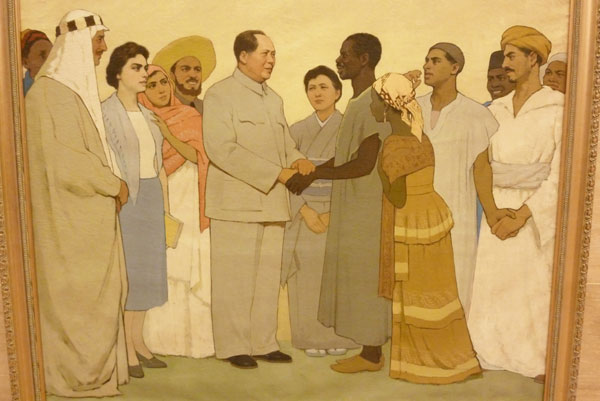
Cultural Revolution era internationalist painting. Photo by Brian Lander.
Cultural Revolution-era internationalist painting. Photo by Brian Lander.

1. Course Requirements
2. MA Thesis Requirement
3. Residence Units
4. Language Requirements
5. Length of Study
6. Transfer Credit and Advanced Standing
7. Advising
8. Written Work, Grades, and Satisfactory Academic Progress
9. Leave of Absence, Withdrawal, and Reinstatement
10. Continuing to a PhD Program
11. Degree Conferral Deadlines
12. MA Degree Requirements Checklist Instructions
13. MA Research Matching Funds
14. Policy on Satisfactory Academic Standing

1. Course Requirements

For students of Chinese, Japanese, Korean, Vietnamese, and Tibetan Studies

The student must take six one-semester content courses (in addition to EAAS GR6990 and GR6991, see below) for a letter grade of B or higher. Classes taken for Pass/Fail or for ‘R’ credit do not count toward the degree. This will give the student a total of 24 course credits according to the normal counting of credit/hr. All courses must be at the 4000-level and above. 4000-level courses in EALAC are graduate/advanced undergraduate seminars. 6000-level, 8000-level, and 9000-level courses in EALAC are graduate colloquia and research seminars. Students can expect the level of difficulty and amount of material in the target language to increase from the 6000 through 9000 levels. The student is strongly urged to take higher (6000-level and above) graduate level courses when possible.

Any combination of EALAC graduate courses will count toward the degree. Classes can be outside the student’s area of specialization. Students may also take relevant courses in other departments, but these courses must be approved by the MA Program Director prior to registration if they are to count toward the content course requirement. Students must submit a brief rationale, the course name, instructor, course description, and syllabus (when it is available). If the course is in addition to those required by the department, no special permission is needed.

EALAC offers two methodology courses in the spring semester designed for students in the EALAC MA program: EAAS GR6200, “Workshop in East Asian History”; EAAS GR6400, “Critical Approaches to East Asian Studies.” These courses will familiarize EALAC MA students with the critical approaches necessary to analyze East Asian history, literature, film, and culture in a comparative framework. These courses will also provide students with strategies for writing research papers and the MA thesis. The student is required to take the methodology course appropriate to his or her discipline, to be determined in consultation with the MA thesis advisor. The required MA methodology course does not count for one of the six required content courses. It must be taken in addition to the six content courses. 

Students may apply up to two semesters of Classical Chinese, two semesters of Classical Japanese, two semesters of Classical Tibetan, or one semester of Advanced Korean in Mixed Script (Korean GR8010) toward the six required content courses. One year of modern languages (Chinese, Japanese, and Korean) in the fourth- or fifth-year level can also be applied toward one of the six required content courses if the student is a non-native speaker. The total number of content courses that can be fulfilled through language courses cannot exceed two. One methodological course in language pedagogy may be accepted towards the six-course requirement.

The choice of courses must be approved by the MA Director.

For students of Chinese Pedagogy

Students of Chinese pedagogy must take seven one-semester content courses for a letter grade of B or higher. All courses must be at the 4000-level and above. Additionally, all students must register for the MA Thesis Research and MA Thesis Writing independent study courses (2 credits each, see item 2 below). This brings the total course credits to 32.

Students may take relevant courses in other departments, or at Teachers College, but these courses must be approved by the Chinese Pedagogy Program Director prior to registration if they are to count toward the degree. Students must submit a brief rationale, the course name, instructor, course description, and syllabus (when it is available). If the course is in addition to those required by the department, no special permission is needed. Below are the required courses:

  1. CHNS GU4301 Intro to Classical Chinese I
  2. CHNS GU4302 Intro to Classical Chinese II
  3. CHNS GU4019 History of the Chinese Language
  4. CHNS GU4904 The Acquisition of Chinese as a Second Language
  5. CHNS GR5001 Chinese Linguistics and Language Pedagogy
  6. (1) Chinese history course [elective]
  7. (1) Chinese literature course [elective]
  8. EAAS GR6990 MA Thesis Research
  9. EAAS GR6991 MA Thesis Writing

2. MA Thesis Requirements

The student must, under the supervision of the MA thesis advisor, write an MA thesis that makes significant use of sources in the East Asian target language.

The MA thesis receives a total of 4 credits, which are divided between 1) EAAS GR6990: “MA Thesis Research” (2 credits) followed by 2) EAAS GR6991: “MA Thesis Writing” (2 credits).  Both courses are taken for a letter grade. Please note that Chinese Pedagogy students must also register for these courses.

1) The student is required to register for EAAS GR6990: “MA Thesis Research,” offered in two segments from the Spring to the Fall semester, in conjunction with the methodology course. The student is required to work with his/her advisor closely to develop the thesis proposal and bibliography. The thesis proposal, in six pages, should describe the main argument, methodology, scope of sources, and scholarly contributions of the thesis, and it should be accompanied by a bibliography.

2) The MA thesis, which should be between 30 and 60 pages, must be approved by the advisor with a letter grade and submitted to the MA Program Director. Students are required to register for EAAS GR6991: “MA Thesis Writing” in order to receive credits for the thesis and to meet with their MA thesis advisors at least twice each semester. Students are permitted to take the MA thesis writing course ONLY when they have their thesis proposals approved by their advisors (a letter grade received for the MA thesis research course).

3. Residence Units

In addition to registering for individual courses, students are required to register for Residence Units (RU), which provide the basis for tuition charges. At least two full Residence Units – the equivalent of one year of full tuition – are required for the free-standing Master of Arts degree in EALAC.

Although most MA students attend full-time, one may also obtain the MA degree through part-time study. Part-time students must complete the degree in no more than four years.

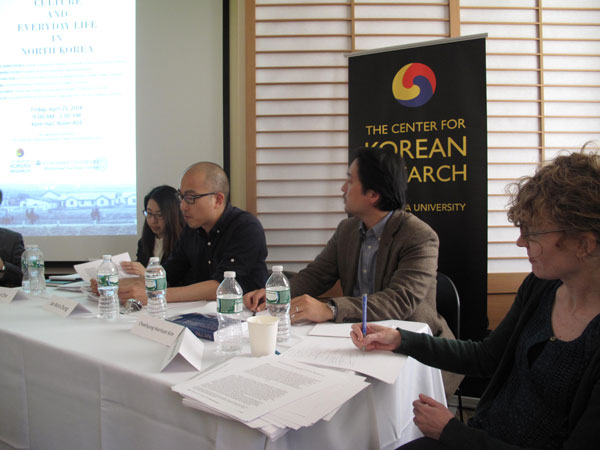
Culture and Everyday Life in North Korea panel discussion

Culture and Everyday Life in North Korea panel discussion

4. Language Requirements

All entering students who have received a B.A. from an institution in which instruction is conducted in a language other than English must take the American Language Program Placement Test during the registration period of the fall semester. Students who do not pass the Placement Test must, in consultation with the MA Program Director, take appropriate American Language Program courses.

Entering students are required to take the language placement examination in the East Asia language of specialization at the beginning of the semester in which they enter the program, unless that language was the primary language of instruction at the institution from which they received the B.A. degree.

To count toward meeting degree requirements, all language courses must be taken for a letter grade of B or higher.

Language requirements are listed below by field:

Chinese Studies Requirements

Three years of modern Chinese, or the equivalent demonstrated by the department’s placement exam, are required for completion of the degree. Students who remain in the program after satisfying this requirement are expected to continue language study throughout their time in the program, either at more advanced levels of Chinese or through study of an additional East Asian language. Study of classical Chinese is strongly encouraged, especially for students concentrating in literature or premodern history.

Japanese Studies Requirements

Three years of modern Japanese, or the equivalent demonstrated by the department’s placement exam, are required for completion of the degree. Students who remain in the program after satisfying this requirement are expected to continue language study throughout their time in the program, either at more advanced levels of Japanese or through study of an additional East Asian language. Study of classical Japanese is strongly encouraged, especially for students concentrating in literature or premodern history.

Korean Studies Requirement

Three years of Korean, or the equivalent demonstrated by the department’s placement exam, are required for completion of the degree. Students who remain in the program after satisfying this requirement are expected to continue language study throughout their time in the program, either at more advanced levels of Korean or through study of an additional East Asian language.

Tibetan Studies Requirement

Two years of modern Tibetan are required. Study of classical Tibetan is strongly encouraged, especially for students concentrating in literature or history before 1950. Students who remain in the program after satisfying this requirement are expected to continue language study throughout their time in the program, either at more advanced levels of Tibetan or through study of Chinese.

Vietnamese Studies Requirement

Three years of Vietnamese, or the equivalent demonstrated by the department’s placement exam, are required for the completion of the degree.

Chinese Pedagogy Requirement

Native or near-native fluency in modern Chinese is required. Students are also required to complete at least two semesters of classical Chinese (as outlined in the course requirements above).

5. Length of Study

Full-time students in the MA program typically take 2 years (4 semesters) to complete the MA degree. According to this timeline, the first year is dedicated to course work and language training, while the second year is devoted to developing the MA thesis project. Depending on the student’s language levels coming into the program, it is possible to complete the MA degree in fewer than 4 semesters. Because a compressed timeline requires a heavy course load and advanced planning, any student wishing to expedite the MA degree must closely consult with the MA Director about their schedule.

Program models, demonstrating different lengths of study, can be found here.

6. Transfer Credit and Advanced Standing

Transfer credit may be awarded to students who have completed graduate-level coursework at Columbia while not being matriculated in GSAS (i.e., students who have completed classes in the School of Continuing Education). Students consult with the MA Program Director regarding the amount of transfer credit allowed.

The Department does not offer advanced standing toward the MA.

7. Advising

All first year MA students must attend the Orientation session, typically held at the end of August, just prior to the official start of Fall classes. Each student will arrange to meet with the MA Program Director to plan their fall course schedule, or address general issues about the structure of the program. Students of Chinese Pedagogy should meet with their director, Professor Lening Liu, who will serve as their academic advisor.

Based on applications materials identifying a given student’s primary area or topic of interest, an academic advisor will be assigned to all incoming students. The academic advisor is a faculty member who is responsible for guiding the research and writing of the MA Thesis. Students should make every effort to take a course offered by their advisor during their first semester, only excepting cases where the advisor is on leave. Academic advisors should meet in person with their advisees at least twice per semester, and should be prepared to respond via e-mail to questions that may come up during summer and winter breaks as students consider their options for the upcoming semester. It is the advisee’s responsibility to get in touch with the advisor as questions arise, and to arrange for face-to-face meetings, at least once during registration, then one around the middle or toward the end of classes. The first meeting should focus on course selection, while the second meeting gives the advisee a chance to say how things are going generally, to discuss any specific issues or problems that are arising with a course or with the workload overall, and to begin to think ahead to the next term. While advisees are expected to take the initiative in scheduling meetings, advisors in turn are expected to make it a priority to find time to meet when asked, during office hours when mutually convenient, or otherwise at another time. At least twenty minutes should be blocked out for the two basic meetings each semester. Advisors should not hesitate to be in touch with the MA Program Director, the Director of Graduate Studies, or department administrators on any uncertain questions, or when an issue arises that should be brought to the attention of those who are overseeing the graduate program.

Students with questions about changing advisors should consult with the MA Program Director.

8. Written Work, Grades, and Satisfactory Academic Progress

Written Work

With the exception of the MA thesis, which may be developed from a paper originally written for course credit, no written work in the MA program may be submitted more than once for credit. Students are responsible for avoiding plagiarism and following the Graduate School’s general guidelines on academic honesty.

Grades

Students and faculty should consider that both the A and the A- are truly positive grades. Grades of A- do not indicate a lack of satisfactory progress, but simply register good work that can be taken a step further in future.

Grades of B+ signal work that raises concerns, and in the case of an MA student a pattern of B+ grades would indicate someone who shouldn’t go on in the program unless he or she is doing significantly better work in other courses.  B is the minimum grade for counting a course toward degree requirements.

Satisfactory Academic Progress

GSAS has specific rules for satisfactory academic progress for MA students. Permission to register each term is contingent, in part, on judgment that progress in the degree program is satisfactory.

Master of Arts Thesis Honor

Occasionally the EALAC department awards special honors to MA theses, in recognition of their excellence.  Theses awarded departmental honors must be based on original research, and should offer new insights to the fields in which they are written. The recommendation for honors is made by the thesis advisor, in a cover letter addressed to the Director of Graduate Studies.  The letter should highlight the thesis’ strength and special contributions. The nomination is reviewed by the Director of Graduate Studies who, in consultation with the MA Coordinator, may invite a second faculty member in the relevant field to provide additional evaluation if necessary, before giving his or her final approval. The honors will be entered into the department’s permanent records, and the thesis will be preserved in the department’s archive. Students will receive official documentation from the department certifying that their MA thesis received special departmental honors.

9. Leave of Absence, Withdrawal, and Reinstatement

Continuous registration until all degree requirements are completed or until the time-to-degree limit has been reached is required for students in the MA program. Students who wish to take a leave of absence, withdraw from the program, or seek reinstatement should refer to the GSAS website for guidelines.

10. Continuing to a PhD Program

MA students can apply to a PhD program in the fall semester of their first or second year in the MA program. Most students apply to a PhD program after completing the MA degree or in the second year of study. This option has the advantage that applicants will then have completed or made significant progress toward completing the MA thesis, which can be used as a writing sample. Students applying to a PhD program in their second year also have the benefit of a full year’s maturation of their work.

Students are encouraged to submit applications to multiple institutions, as this increases the possibility of acceptance to a PhD program.

11. Degree Conferral Deadlines

Application for Degree

September 1st for October graduation
November 1st for February graduation
December 1st for May graduation

Students planning to graduate in a given semester must apply to graduate through SSOL. The Registrar’s website  provides an explanation and instructions for the form here, but the form itself is on SSOL.

MA Thesis Submission Deadlines

September 22nd for October graduation
January 5th for February graduation
April 19th for May graduation
Students must submit their MA thesis to their advisor by the above dates.

MA Degree Requirements Checklist Form and Approved Thesis

October 15th for October graduation
February 11th for February graduation
May 12th for May graduation

In addition to submitting a degree application to the Office of the Registrar, students must also submit (1) their final, advisor-approved thesis, (2) the MA Degree Requirements Checklist Form (signed by the MA Program Director and advisor(s)), and (3) a copy of your Columbia academic transcript (official or unofficial — with ALL final grades) to the Graduate Program Manager by these dates.

Failure to submit a degree application, thesis, or MA Degree Requirements Checklist may result in major delays in degree conferral.

12. MA Degree Requirements Checklist Instructions

Please incorporate all the revisions suggested by your Thesis Advisor and submit the final manuscript to her/him. When your final manuscript is approved by your advisor, please follow the steps below:

    1. Type out all information on the checklist (the pdf is editable).
    2. Obtain the signature of your thesis advisor on your completed checklist.
    3. Submit by email (1.) the final, advisor-approved version of your thesis, (2.) the completed checklist signed by your advisor, and (3.) a copy of your Columbia academic transcript (official or unofficial) to the Graduate Program Manager by the relevant date listed in 11. Degree Conferral Deadlines.

13. MA Research Matching Funds

GSAS is introducing a new matching fund for MA students who need to conduct research for their final thesis or project during the academic year or the summer months. GSAS may provide up to $250 to match the funding provided by the department/program for a given student.

The application process is similar to that of the Conference Matching Travel Fund and is also published on the GSAS website. Students first submit an application form, research proposal, and budget to the department. The MA Program Director evaluates the merit of the proposal, indicates the amount of funding the department is willing to provide, and forwards the approved application to GSAS to request matching funds. Applications will be considered in the order they are received, until GSAS funds for that academic year and following summer are exhausted or the final application deadline of May 1 is reached, whichever occurs earlier.

14. Policy on Satisfactory Academic Standing

Good academic and administrative standing are required for continued enrollment in the MA program.  Good academic standing is constituted by:

  • Maintaining consistent contact with the academic advisor
  • Maintaining a cumulative grade point average of at least 3.0
  • Holding no more than one mark of Incomplete at any given time

Good administrative standing entails being in compliance with all applicable administrative policies and procedures of the university.

Failure to maintain good academic or administrative standing may result in academic or administrative warning, probation, suspension, or dismissal.  Students who are not in good standing will be advised regarding corrective steps to take, the deadlines for doing so, and the consequences of failing to remedy the matter.  A student who fails to take corrective steps within the specified time limit will be terminated from candidacy for his/her degree. In cases of evident and extreme failure to achieve progress, a student may be dismissed from the degree program without a probationary period.  All students are expected to familiarize themselves with the EALAC policies and procedures.  For more information regarding Good Standing please see the GSAS Policy Handbook.  Students can also reach out to the MA Program Director, the DGS, and/or the Associate Director of Academic Programs.

Language Requirements

Language Requirements

All entering students who have received a B.A. from an institution in which instruction is conducted in a language other than English must take the American Language Program Placement Test during the registration period of the fall semester. Students who do not pass the Placement Test must, in consultation with the MA Program Director, take appropriate American Language Program courses.

Entering students are required to take the language placement examination in the East Asia language of specialization at the beginning of the semester in which they enter the program, unless that language was the primary language of instruction at the institution from which they received the B.A. degree.

Culture and Everyday Life in North Korea panel discussion

To count toward meeting degree requirements, all language courses must be taken for a letter grade of B or higher.

Language requirements are listed below by field:

Chinese Studies Requirements

Three years of modern Chinese, or the equivalent demonstrated by the department’s placement exam, are required for completion of the degree. Students who remain in the program after satisfying this requirement are expected to continue language study throughout their time in the program, either at more advanced levels of Chinese or through study of an additional East Asian language. Study of classical Chinese is strongly encouraged, especially for students concentrating in literature or premodern history.

Japanese Studies Requirements

Three years of modern Japanese, or the equivalent demonstrated by the department’s placement exam, are required for completion of the degree. Students who remain in the program after satisfying this requirement are expected to continue language study throughout their time in the program, either at more advanced levels of Japanese or through study of an additional East Asian language. Study of classical Japanese is strongly encouraged, especially for students concentrating in literature or premodern history.

Korean Studies Requirement

Three years of Korean, or the equivalent demonstrated by the department’s placement exam, are required for completion of the degree. Students who remain in the program after satisfying this requirement are expected to continue language study throughout their time in the program, either at more advanced levels of Korean or through study of an additional East Asian language.

Tibetan Studies Requirement

Two years of modern Tibetan are required. Study of classical Tibetan is strongly encouraged, especially for students concentrating in literature or history before 1950. Students who remain in the program after satisfying this requirement are expected to continue language study throughout their time in the program, either at more advanced levels of Tibetan or through study of Chinese.

Vietnamese Studies Requirement

Three years of Vietnamese, or the equivalent demonstrated by the department’s placement exam, are required for the completion of the degree.

Chinese Pedagogy Requirement

Native or near-native fluency in modern Chinese is required. Students are also required to complete at least two semesters of classical Chinese (as outlined in the course requirements above).

  • « Go to Previous Page
  • Go to page 1
  • Interim pages omitted …
  • Go to page 3
  • Go to page 4
  • Go to page 5
  • Go to page 6
  • Go to page 7
  • Go to page 8
  • Go to Next Page »

Primary Sidebar

Before Footer

EALAC – Columbia University
407 Kent Hall 1140 Amsterdam Ave.
MC 3907  New York, NY 10027
tel:212.854.5027

Footer

  • Facebook
  • Instagram
  • Twitter
  • ABOUT
  • PEOPLE
  • PROGRAMS
  • EVENTS
  • SUPPORT

Copyright © 2026 · Columbia University Department of East Asian Languages and Cultures

Copyright © 2026 · EALAC on Genesis Framework · WordPress · Log in