• Skip to main content
  • Skip to footer

  • ABOUT
    • Greetings from the Department Chair
    • Department History
    • News
    • Affiliates
    • Support
    • Contact EALAC
  • PEOPLE
    • Faculty
    • Administration
    • Graduate Students
    • Recent Alumni
  • PROGRAMS
    • Undergraduate
    • Graduate
    • Language Programs
    • Academic Year 2025-2026 Courses
  • EVENTS
  • SUPPORT

core faculty

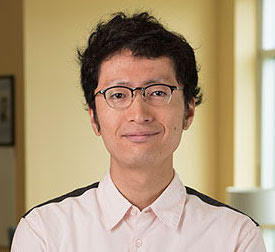
Takuya Tsunoda

Takuya Tsunoda

Assistant Professor of Japanese Film and Media

Office: 416 Kent Hall
Office Hours: On leave for fall 2025
Phone: (212) 854-5040
Email: tt2101@columbia.edu

Educational Background

BA: Waseda University (’02), Columbia University (’05)
MA: Columbia University (’08)
PhD: Yale University (’15)

Classes Taught

EAAS UN3322 East Asian Cinema
EAAS UN3343 Japanese Contemporary Cinema and Media Culture
EAAS GU4122 Japanese New Wave and Cinematic Modernism
EAAS GU4123 Japanese Documentary Films
EAAS GR6400 Critical Approaches to East Asian Studies: Literary and Cultural Theory
EAAS GR8070 Graduate Seminar in Japanese Cinema and Visual Culture

Research Interests

Japanese cinema and media, educational and science film, industrial cinema, history and theory of audio-visual pedagogy, media archaeology, cinematic modernism, new cinemas of the 1960s, television

Takuya Tsunoda’s primary research centers on the interplay between institutions and media, technologies and socio-cultural practices, science and material culture, and representation and knowledge formations. He is currently at work on a book project about Iwanami Productions, which evolved from a major provider of sponsored educational, science and public relations films into a key player in the new cinemas of the 1960s in Japan. Grounding his research in archival materials, he highlights the historical and theoretical intersection between media-based governmental and civic activities, cross-medial articulation of postwar academicism in Japan, and a postwar struggle over the legacy and meaning of cinematic modernism. Looking beyond the activist logic of political radicalism, his book argues that the crucial root of new cinemas in Japan resided in institutionalized audio-visual pedagogy and image-making practice. This project works towards new transnational parameters that relate the cinematic New Wave to a range of epistemic transformations and changing mediascapes occurring in the period. His recent research interests extend to such topics as various modes of reflexivity, children and media, the emergence of alpine photography and insect ecology, television documentaries as well as the relationship between diegesis and contemporary media cultures.

Prior to joining the Columbia faculty, he taught at Colgate University and the University of Chicago.

Selected Publications
“Taxonomy of Techniques: Visions of Industrial Cinema in Postwar Japan,” in Films That Work Harder: The Circulations of Industrial Cinema (Amsterdam, forthcoming)
“Hani Susumu, Nouvelle Vague in Japan and Processive Cinema,” in A Companion to Japanese Cinema (Blackwell, 2022), pp. 612-638.
“The Living Sea: Okinawa, 1958 and the postwar media Dispositif.” Journal of Japanese and Korean Cinema 13:2 (Nov. 2021), pp. 99-117.
“Iwanami Photo Library and Natori Yōnosuke on Photography,” in Mediology in the Transformative Period: Reconfiguration of Art and Media in 1950s Japan (Shinwasha, 2019, in Japanese)“Index and Deixis: Jinba Isao and Polluted Water Karte,” in Images of Postwar Japan: Pollution, Youth Rebellion, and the Osaka Exhibition (Univ. of Tokyo, 2018, in Japanese)

Dominique Townsend

Dominique Townsend

Professor of Indo-Tibetan Buddhism, Department of Religion

Office: 480 Claremont Ave Ste, Suite 103, MC 9610, New York NY
Office Hours: Tuesdays, 11:00am – 1:00pm and by appointment
Phone: 212-853-5640
Email: dt80@columbia.edu

Background
Dominique Townsend is a scholar of Tibetan Buddhism whose research combines historical and literary methods. Her interests include Tibetan Buddhist cultural production, poetry, aesthetics, dreams, gender, and translation. Her research is rooted primarily in Classical Tibetan texts, with an emphasis on the seventeenth-twentieth centuries. She teaches courses on Tibetan Buddhism and history, Asian humanities, poetics, new media, dreaming, and Buddhist approaches to death and dying. Before joining the faculty at Columbia in July 2024, she was Associate Professor of Religion at Bard College, and prior to that she served as Head of Interpretation at the Rubin Museum of Art.
Research Interests

Currently Townsend’s research is focused on a book about dreams and dreaming in Tibetan Buddhism, All this is Dreamlike, forthcoming from Columbia University Press. Her previous books include A Buddhist Sensibility (Columbia University Press, 2021), and the co-edited, Longing to Awaken, (University of Virginia Press, 2024). She has also published a book of poems and a children’s book.

Tomi Suzuki

Tomi Suzuki

Professor of Japanese Literature, Director of Graduate Studies

Office: 410 Kent Hall
Office Hours: On leave 2025-26
Phone: (212) 854-5034
Email: ts202@columbia.edu

Educational Background

BA: University of Tokyo (’74)
MA: University of Tokyo (’77)
PhD: Yale University (’88)

Classes Taught

AHUM U3830 Colloquium on Modern East Asian Texts
JPNS GU4008 Readings in Classical Japanese
JPNS GR9020 Graduate Seminar in Modern Japanese Literature

Research Interests

Modern Japanese Literature and Criticism in Comparative Context, Literary and Cultural Theory, Narrative, Genre, and Gender Theory, Modernism and Modernity, Intellectual History of Modern Japan, History of Reading

Professor Suzuki joined the department at Columbia University in 1996. She has published extensively in both the English and Japanese languages.  Currently, Professor Suzuki is completing a book entitled Gender, Literary Culture, and Nation in Japan: 1880s-1950s, which investigates the formation of the literary field from the late nineteenth century to the postwar period in relationship to gender construction, language reform, and education. It explores the modernist construction and questioning of Japanese linguistic and cultural traditions in a transnational context. Most recently, she co-edited The Cambridge History of Japanese Literature.

Selected Publications

The Cambridge History of Japanese Literature (co-editor, Cambridge, 2016).

“Translations and Modern Japanese Literature: Re-reading Mori Ogai’s Maihime at Columbia University,” Bungaku (2014, in Japanese)

“Transformations and Continuities: Censorship and Occupation-Period Criticism,” in Occupation-period Literary Journals: 1946–1947, vol. 2 (Iwanami Shoten, 2010, in Japanese)

Censorship, Media, and Literary Culture in Japan (author and co-editor, Shin’yōsha, 2012)

Inventing the Classics: Modernity, National Identity, and Japanese Literature (author and co-editor, Stanford University, 2001)

Narrating the Self: Fictions of Japanese Modernity (Stanford, 1996)

  • « Go to Previous Page
  • Go to page 1
  • Go to page 2
  • Go to page 3
  • Go to page 4
  • Interim pages omitted …
  • Go to page 9
  • Go to Next Page »

Before Footer

EALAC – Columbia University
407 Kent Hall 1140 Amsterdam Ave.
MC 3907  New York, NY 10027
tel:212.854.5027

Footer

  • Facebook
  • Instagram
  • Twitter
  • ABOUT
  • PEOPLE
  • PROGRAMS
  • EVENTS
  • SUPPORT

Copyright © 2026 · Columbia University Department of East Asian Languages and Cultures

Copyright © 2026 · EALAC on Genesis Framework · WordPress · Log in